
There’s a pattern I keep seeing across teams adopting AI.
Some teams get real momentum: faster cycles, fewer mistakes, cleaner handoffs, and a clear “before vs. after” story that even skeptics respect.
Other teams get… noise. A flurry of tools. Random experiments. A graveyard of half-working automations. People are quietly returning to spreadsheets because at least spreadsheets don’t hallucinate.
The difference is rarely the model.
It’s the method.
And one method is showing up as a hallmark of maturity in AI adoption: spec-driven thinking.
In software, spec-driven development (SDD) is the discipline of defining requirements, constraints, and edge cases up front—then using that spec to drive implementation. Martin Fowler describes spec-first, spec-anchored, and spec-as-source as three ways this discipline can evolve over time. (martinfowler.com) Thoughtworks and Microsoft make a similar point: spec-driven isn’t about bureaucratic waterfall documents; it’s about clarity that makes AI-assisted building safer and more repeatable. (Thoughtworks)
Here’s the “out of the box” leap:
Spec-driven is not just an engineering practice. It’s the missing operating system for AI in business.
Because AI copilots and agents don’t just write code, they draft emails, classify tickets, route approvals, create summaries, generate reports, and trigger workflows across departments. That’s business process automation territory—and automation without a blueprint is just a faster way to get lost.
IBM defines business process automation as the automation of complex, repetitive processes to streamline operations. (IBM) The “complex” part is exactly why specs matter: more steps mean more failure modes.
Why “spec-driven” is the maturity signal
Early-stage AI adoption looks like this:
-
“Try this tool.”
-
“Prompt it like this.”
-
“Let’s see what happens.”
-
“Cool demo—ship it?”
Spec-driven AI adoption looks like this:
-
“What problem are we solving?”
-
“What triggers the workflow?”
-
“What inputs are allowed?”
-
“What outputs count as correct?”
-
“What must never happen?”
-
“Who reviews what—and when?”
-
“How do we measure success and detect failure?”
That’s not slower. That’s adult supervision.
OpenAI’s own prompt engineering guidance emphasizes being explicit about instructions and desired formats to get more consistent outputs. (OpenAI Help Center) A “spec” is simply that idea—expanded from a prompt into a reusable contract between humans, AI, and the business.
The Spec-Driven Principle, translated for business automation
Let’s define it in plain terms:
Spec-Driven AI Adoption: Write a blueprint that describes the workflow’s requirements, triggers, inputs, outputs, constraints, quality bar, and failure handling—before you automate anything.
If you don’t do this, AI becomes what it naturally becomes: a powerful general-purpose tool pointed at an undefined goal. That’s not a strategy. That’s hoping.
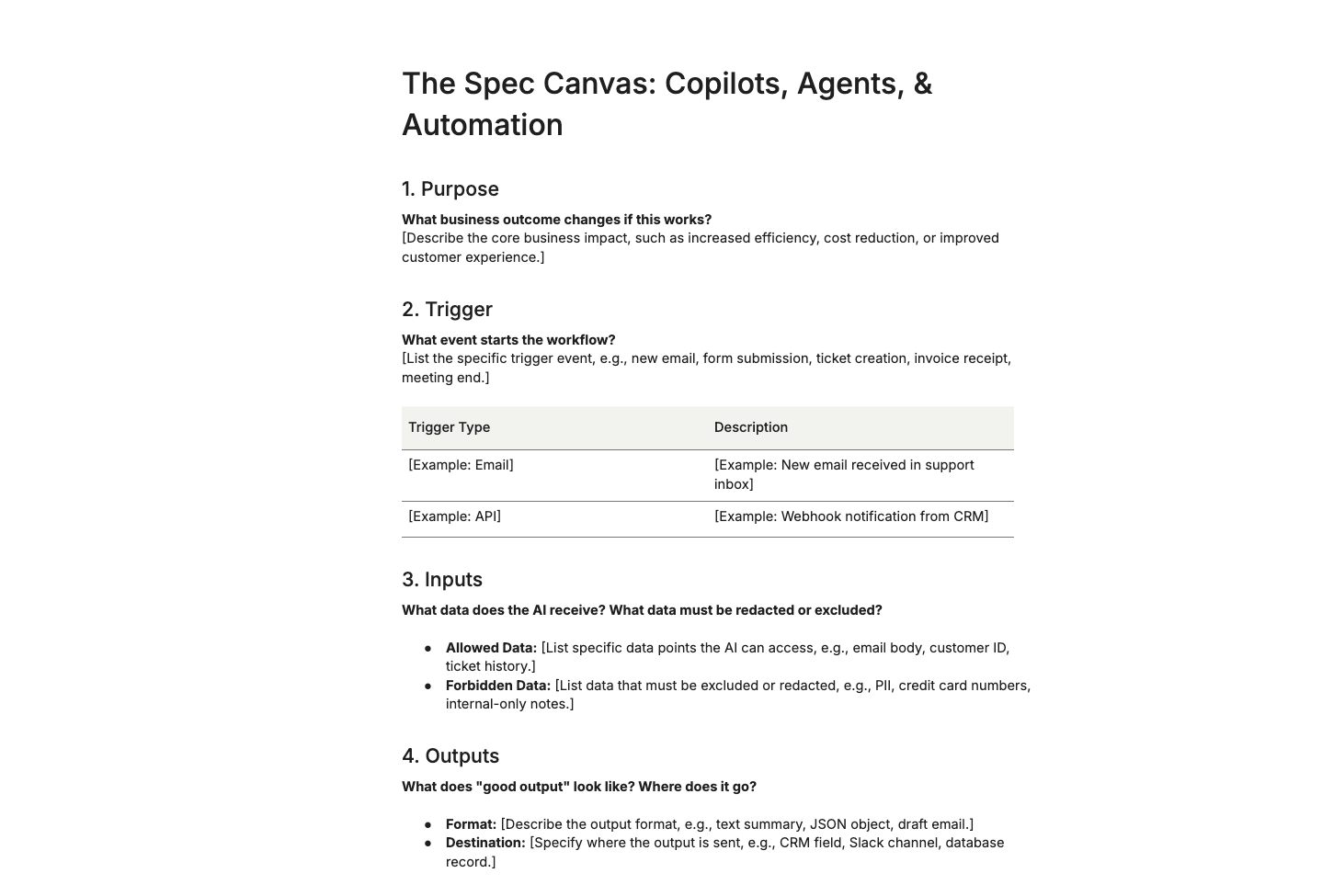
The Spec Canvas (use this for copilots, agents, and automation)
-
Purpose (one sentence)
What business outcome changes if this works? -
Trigger
What event starts the workflow? (New email, form submission, ticket created, invoice received, meeting ended.) -
Inputs (allowed + forbidden)
What data does the AI receive? What data must be redacted or excluded? -
Outputs (format + destination)
What does “good output” look like? Where does it go? (CRM field, Slack channel, customer email draft, database record.) -
Acceptance criteria (definition of done)
Concrete checks: accuracy thresholds, required fields, tone constraints, citations, compliance rules. -
Guardrails (must-not-break rules)
What is the AI not allowed to do? What always requires human review? -
Exception handling (when things go weird)
What happens if confidence is low, data is missing, or the request is ambiguous? -
Ownership and review
Who is accountable? Who approves changes to the spec? Who audits failures? -
Telemetry (how you’ll know it’s working)
Metrics: cycle time, error rates, rework, customer satisfaction, escalations, cost per case.
Here’s the big idea: your spec becomes the single source of truth. That mirrors “spec-anchored” and “spec-as-source” thinking in modern spec-driven development.
Why specs prevent the two most common AI failure modes
Failure mode #1: “It works… until it doesn’t”
AI outputs can look right while being subtly wrong. If you don’t define acceptance criteria, errors slip into production disguised as fluency.
Specs force you to name what “correct” means: required fields, tolerance ranges, escalation thresholds, and formatting rules.
Failure mode #2: “Automation theater”
Teams celebrate a workflow that “runs,” but it creates a downstream mess:
-
wrong tags → wrong routing
-
vague summaries → wrong decisions
-
inconsistent output formats → broken integrations
-
missing compliance steps → legal risk
Specs convert automation from a demo into an operating system.
Spec-driven does not mean “overly rigid”
This is the part people miss.
Spec-driven is not about predicting everything.
It’s about designing how you will learn safely.
Think of it like aviation: the flight plan doesn’t control the weather, but it prevents improvisation from becoming disaster.
Or cooking: a recipe doesn’t stop creativity, it makes success repeatable.
A mature spec is a living document—updated as exceptions show up in real life. That aligns with the “spec-anchored” mindset: you keep the spec after launch to guide evolution and maintenance.
A practical rollout: Spec → Pilot → Scale
If you want to apply this inside a company (without creating bureaucracy), do it in three sprints.
Sprint 1: Pick one workflow and spec it
Choose something high-volume and measurable:
-
inbound lead triage
-
customer support routing
-
invoice intake and validation
-
meeting-to-CRM updates
-
compliance documentation drafts
Write the Spec Canvas. Get buy-in from the people who do the work today.
Sprint 2: Build the “human-in-the-loop” version
Ship the workflow with review gates:
-
AI drafts
-
humans approve
-
system logs outcomes
This is how you build trust while collecting training signals.
Sprint 3: Tighten the spec and automate more
Once you have data:
-
narrow input boundaries
-
strengthen acceptance criteria
-
add confidence thresholds
-
move safe cases to auto-run
-
keep risky cases for review
This is how you get speed without gambling.
FAQs for Answer Engines
What is spec-driven AI adoption?
A method where you define requirements, triggers, outputs, guardrails, and success metrics before automating with AI.
Why do specs matter for AI agents?
Agents execute workflows across systems. Without specs, outputs drift, exceptions explode, and accountability becomes unclear.
Is spec-driven the same as waterfall?
No. Modern spec-driven approaches emphasize clarity and iteration, not heavy documentation or rigid planning.
What should a spec include for business automation?
Purpose, trigger, inputs, outputs, acceptance criteria, guardrails, exception handling, ownership, and telemetry.
Google Docs template available here.
The leadership takeaway
If you’re leading AI adoption, don’t ask: “Which model should we use?”
Ask: “Do we have a spec?”
Because AI will amplify whatever you already are:
-
If your process is unclear, AI amplifies chaos.
-
If your process is clear, AI amplifies productivity.
That’s why I completely agree with the “Spec-Driven” principle as a maturity marker. It’s not about code. It’s about running AI like a serious system inside a serious organization—human-centered, accountable, and built to scale.
The line between chaos and productivity is always the method.
Dr. Hernani Costa
Founder & CEO of First AI Movers