

Good morning and welcome to your end-of-week edition of First AI Movers Pro. The AI landscape in recent days has been buzzing with big moves. Europe just unveiled a sweeping plan to become an “AI continent,” the U.S. is resetting its AI policies, and even China’s leaders are doubling down on homegrown innovation. The race to AI leadership is truly global now. In today’s newsletter, we’ll break down what Europe’s bold strategy means for innovators, plus quick hits on the latest AI, automation, and tech shifts shaping our future. Grab your coffee – let’s dive in!
Hot Links You Might Have Missed
-
EU launches consultation on future digital tech – Brussels seeks input on which emerging technologies (AI, quantum, etc.) to prioritize beyond 2027.
-
UK’s FCA to sandbox AI for banks – Britain’s financial regulator will launch a supervised “live AI testing” sandbox in September to let banks trial AI models under watchdog oversight.
-
White House tells agencies to lean into AI – The U.S. administration orders federal agencies to embrace AI use (naming chief AI officers) while rolling back some prior risk guidelines in a push for “pro-innovation” government tech.
-
China’s Xi champions AI self-reliance – At a Politburo session, President Xi Jinping urged “self-strengthening” in AI development to close the tech gap with the U.S., pledging policy support for chips, talent, and research.
-
EU AI & health startups see record funding – European AI and healthtech firms raised $13.9 B in Q1 2025, a slight uptick year-on-year, as global investors show unprecedented interest in Europe’s tech scene.
Main Article – Europe’s ‘AI Continent’ Power Play
Europe has decided it’s done being timid about artificial intelligence. This week, officials in Brussels rolled out an ambitious AI Continent Action Plan – a blueprint to transform the EU’s rich industrial base and research talent into a world-leading AI powerhouse. The plan checks all the boxes: new “AI factories” across the bloc, massive investment in computing and data, strategies to boost AI adoption in industry, and an emphasis on skills and trustworthy AI. It’s a bold bid to close the gap with the U.S. and China by playing to Europe’s strengths (and fixing its weaknesses). In short, Europe is making an AI power play, and it’s telling the world that now is the time to act.
“The global race for AI is far from over. The time to act is now.”
Step back for a second: why does Europe need an “AI action plan” at all? For one, despite AI’s potential, only about 13.5% of EU companies use AI in their operations (Action plan launched to boost European AI innovation). That’s a stark reality check. EU leaders worry that without intervention, European industry could fall behind as others charge ahead. Enter the AI Continent Action Plan, unveiled by the European Commission to jolt the region’s digital transformation into high gear. The sentiment in Brussels is that Europe has no choice but to double down on AI – in a uniquely European way – or risk irrelevance. As one official put it, the plan is about making Europe “more competitive, secure and technologically sovereign” in an AI-driven world.
So, what’s actually in this grand plan? Think of it in a few big chunks – infrastructure, applications, people, and rules – all underpinned by serious investment. First, the infrastructure: Europe is building out a network of “AI factories.” Don’t picture smokestacks – picture clusters of cutting-edge supercomputers humming away on AI research. Thirteen such AI hubs are already under construction across countries from Finland to Spain. And on the horizon: even larger AI “gigafactories,” industrial-scale centers each loaded with over 100,000 high-performance AI chips (4× the power of today’s top supercomputers). These mega-compute centers will turbocharge the development of advanced AI models and help ensure Europe isn’t dependent on others for critical AI infrastructure. It’s the EU’s moonshot to secure strategic autonomy in key sectors via raw computing muscle.
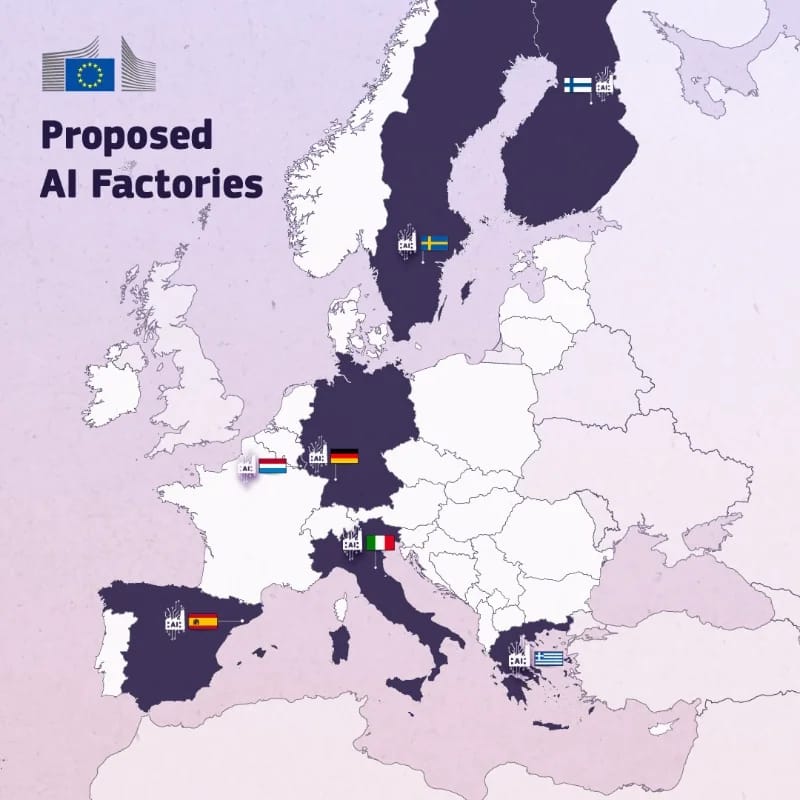
A map of Europe with several high-tech data centers highlighted as “AI factories”.
Then there’s investment. The EU is rallying funds to fuel this AI engine – mobilizing up to €20 B in private investments through an initiative called InvestAI, and planning a Cloud and AI Development Act to stimulate even more spending on cloud capacity (with a goal to triple Europe’s data center capacity in seven years). In other words, they’re putting serious money on the table to build and host the next generation of AI, and to do it in a green, scalable way. This is about laying down the hardware and cloud foundation so that European innovators have home turf to innovate on, rather than relying on Silicon Valley’s servers.
But shiny infrastructure isn’t much use if companies don’t actually use the tech. A key part of the plan tackles this adoption gap head-on. The Commission is kicking off a new “Apply AI” Strategy aimed at helping European industries – from healthcare to automotive to manufacturing – build and deploy AI solutions tailored to their needs. The plan leverages those AI factories and the network of local innovation hubs (so-called Digital Innovation Hubs) to give businesses of all sizes the tools, training, and support to integrate AI. The message is clear: whether you run a car plant in Germany or a hospital in Portugal, the EU wants to help you plug AI into your operations. By seeding sector-specific AI applications and sharing success stories, they hope to lift that stubborn 13.5% adoption rate much higher in the coming years. It’s about democratising AI across the continent, so even mid-sized firms and public services can benefit, not just Big Tech players.
Of course, people are at the heart of this transformation. Europe knows it needs talent to execute on these lofty goals – and to stop losing its brightest minds to elsewhere. So the action plan includes measures to attract and retain AI talent. Programs like an AI Skills Academy and a revamped EU Talent Pool will train tens of thousands in AI skills, while initiatives (such as the MSCA “Choose Europe” program) will create pathways to bring in global AI experts. The EU explicitly talks about reversing the tech “brain drain.” They’re even considering new legal migration routes for AI specialists to bolster the talent base. It’s a recognition that cutting-edge tech isn’t just about hardware and algorithms – it’s about people who know how to build and use them. In the long run, growing a robust workforce of AI researchers, engineers, and savvy users in Europe could be the most pivotal piece of this puzzle.
Now, no discussion of European tech strategy would be complete without mentioning trust and regulation – the hallmarks of the EU approach. The AI Continent Plan doesn’t shy away from this; in fact, it doubles down on Europe’s value of “trustworthy AI.” The EU’s landmark AI Act is already in motion, setting guardrails on high-risk AI systems. To help companies navigate those new rules, Brussels will launch an AI Act Service Desk by summer 2025 – basically a one-stop helpdesk for businesses to get guidance on complying with AI regulations. It’s a very European solution: acknowledge the rules are complex, and then offer free advice to follow them. Moreover, the Commission is currently consulting on guidelines for general-purpose AI (think large models like GPT) and developing a voluntary Code of Practice to promote safe AI ahead of the AI Act’s full implementation in 2025. In short, Europe’s trying to create a safe space for AI innovation – balancing urgency with its trademark caution. As EU officials often remind us, they want “trustworthy AI” to be the European brand. The new plan carries that ethos forward, ensuring that scaling up AI doesn’t mean tossing ethics or privacy out the window.
An interesting aspect of this whole effort is how collaborative it aims to be. The Commission didn’t just drop a finished plan from the sky – they opened public consultations to gather feedback on key pieces of it. Right now, anyone can weigh in on the proposed Cloud & AI Development Act and the Apply AI Strategy (consultations run until June 4, 2025), and a third consultation on the Data strategy is coming later in May. Plus, EU officials are engaging industry leaders and public stakeholders through forums and surveys (even asking organizations to share their best practices in AI education and literacy). It’s a nod to the fact that no single government entity can foresee all the challenges in rolling out AI widely – better to crowdsource some wisdom from startups, corporates, and researchers on the ground. This ongoing dialogue means the plan could evolve with input, and it signals to businesses that their voices are being heard in shaping Europe’s AI future.
All told, Europe’s AI Continent Action Plan is audacious. It paints a future where Europe isn’t just a consumer of AI tech from abroad, but a creator and shaper of AI that aligns with European values. If it succeeds, we could see a wave of home-grown AI breakthroughs, more AI in Europe’s factories and hospitals, and a stronger hand for Europe in setting global AI norms (especially around ethics and governance). There are plenty of hurdles ahead – funding these initiatives, coordinating across 27 countries, and keeping up with blistering innovation in the private sector, to name a few. But the boldness of the plan has many in Europe’s tech community excited. It’s a statement that Europe won’t sit on the sidelines of the AI revolution. Instead, the EU is trying to write its own chapter in the AI story – one where supercomputing hubs, skilled talent, and a focus on “AI you can trust” give the continent a competitive edge. As the world’s AI competition heats up, Europe just went all-in with a big bet on itself. Now the real work begins to turn that vision into reality. Stay tuned – this is a story that’s just getting started.
Tool or Trend Spotlight
Virtue AI – Safeguarding enterprise AI deployments
-
Founded by leading AI security researchers (ex-Berkeley, Stanford) and backed by $30 M funding, this new startup focuses on AI safety & security.
-
What it does: Provides tools for companies to integrate generative AI into products without security headaches. Virtue AI’s platform helps catch and prevent issues like prompt injection attacks, data leaks, or AI “jailbreaks” before they cause trouble.
-
Frees up teams to ship AI features faster by automating many of the guardrails – so businesses don’t have to choose between moving fast and staying safe. It’s essentially an AI security co-pilot for your dev and ops teams.
Why it matters now: As enterprises race to roll out GPT-powered apps and AI assistants, concerns about things like data privacy and adversarial prompts are growing. Virtue AI’s launch shows a rising demand for solutions that let companies embrace AI confidently. By building trust and safety into the deployment pipeline, tools like this could accelerate AI adoption in sectors that have been cautious. In an era of increasing AI regulation and risk awareness, “AI security” is becoming just as hot as AI itself – and a key enabler for responsible innovation.
Fast Fact or Insight of the Day
54% – More than half of Brits haven’t heard of AI being used in healthcare, even though AI tools already assist in 60% of UK cancer centers (54% of Brits unaware AI is being used in healthcare, finds survey). (Public awareness clearly hasn’t caught up with reality — underscoring the need for more education on how AI is quietly improving care.)
Thank you for reading First AI Movers Pro! If you enjoyed this briefing and want to stay ahead in the AI transformation journey, please consider sharing the newsletter or connecting with me on LinkedIn. Let’s grow this community of forward-thinkers – and keep the conversation going.
Stay connected and expand your professional network by connecting with Dr. Hernani on LinkedIn. Whether you’re looking to collaborate, seek advice, or simply stay updated with industry insights, Dr. Hernani is eager to engage with like-minded professionals. Additionally, if you find this newsletter valuable, don’t hesitate to share it with your network by using the share button. Your support helps us reach more readers and continue delivering quality content.