
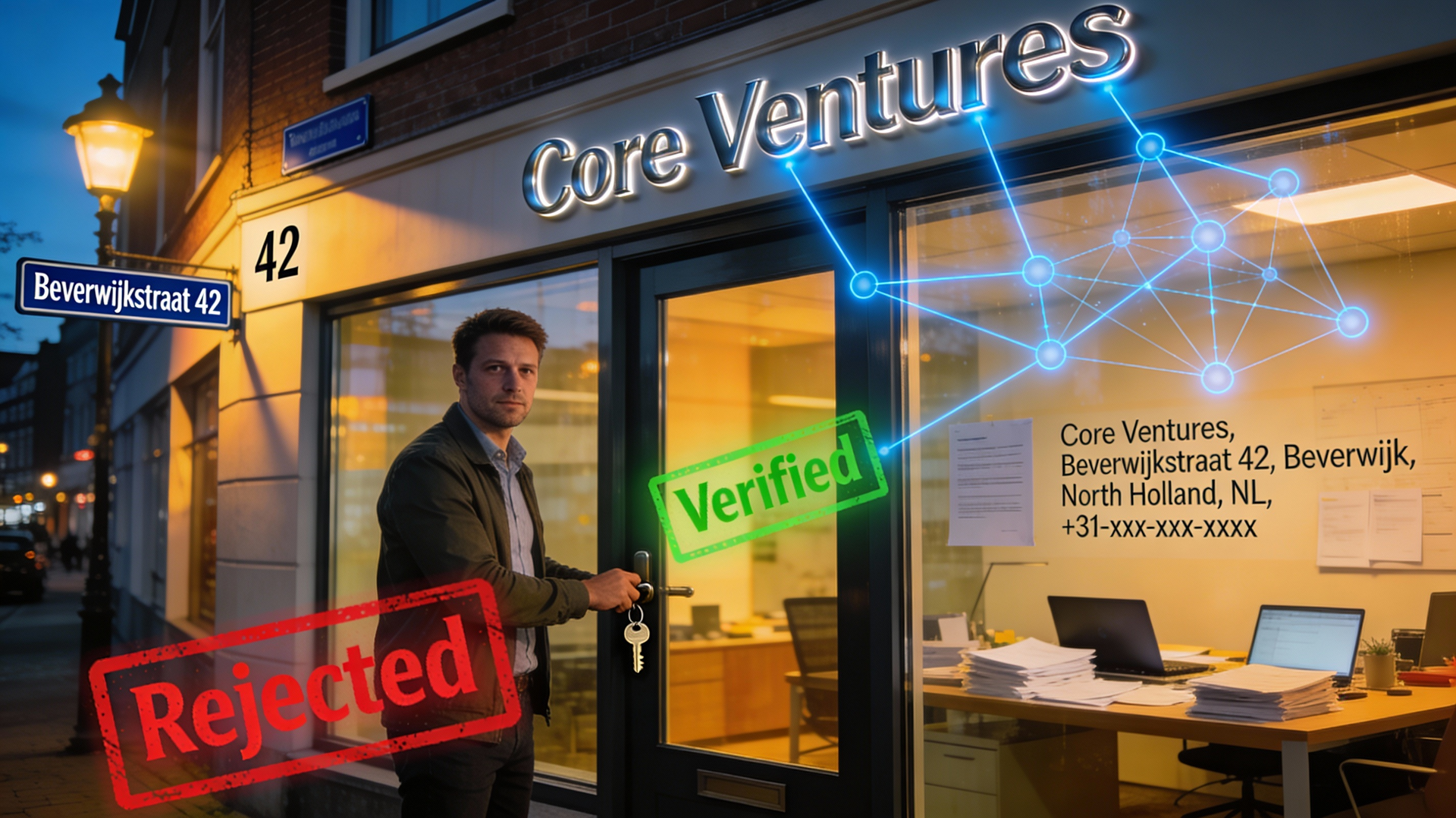
Most business owners think Google Business Profile verification is a formality. Submit your address, wait for a postcard, enter the code, and you’re done. But in January 2026, that process is dead.
Google now requires video verification for most businesses, and rejection rates have surged to levels unthinkable 18 months ago. Sterling Sky data shows that 42% of suspended profiles failed during address verification alone, and suspensions overall have jumped 80% since 2023. Even legitimate, long-standing businesses with proper documentation can be rejected for inconsistencies flagged by Google’s AI detection systems—unclear signage, address mismatches across documents, or shared office spaces without dedicated branding.
But here’s what almost no one understands: GBP verification isn’t a one-time compliance task. It’s the entry point to Google’s entity recognition system.
Without a verified status, your business doesn’t exist in the Knowledge Graph. AI Overviews won’t cite you. Local pack rankings tank. Your carefully chosen categories and service listings become invisible signals that never reach the algorithm. And if your digital footprint is inconsistent across platforms—LinkedIn says one thing, your website says another, your GBP says a third—Google’s AI can’t build a coherent entity profile. You’re training the algorithm to see you as multiple competing businesses rather than as one authoritative source.
Why Is Google Rejecting So Many Business Profiles in 2026?
Google’s verification process has become exponentially stricter as the company prepares its local search ecosystem for AI-driven answers. AI Overviews, Generative Engine Optimization (GEO), Search Generative Experience (SGE), and other LLM-powered features require high-quality, verified entity data to function accurately. If Google’s Knowledge Graph contains spam, fake listings, or conflicting information, its AI-generated summaries become unreliable.
The spam epidemic forced Google‘s hand. Fraudsters have used automation and AI tools to create fake business listings at scale, flooding local search results with profiles that temporarily outrank legitimate businesses. Google’s response has been a dual strategy: aggressive algorithmic detection combined with stricter manual verification requirements.
Video verification is now the default option for most businesses because it’s far harder to fake than a postcard sent to a virtual office. The video must be recorded in one continuous shot, uploaded directly through the GBP interface (no pre-recorded uploads), and demonstrate three specific proofs: geographical location (street signs, building numbers, nearby landmarks), business existence (permanent signage matching your GBP name), and authorization to represent the business (unlocking doors with keys, accessing staff-only equipment, showing business documents with matching NAP data).
Common rejection triggers include PO boxes, virtual offices, coworking spaces without dedicated signage, temporary paper signs taped to doors, and any NAP inconsistencies between your GBP, website, utility bills, business license, and other documents. Even minor discrepancies—like listing “123 Main Street Suite 4” on your GBP but “123 Main St. #4” on your lease agreement—can trigger algorithmic flags.
What Does GBP Verification Have to Do With Entity Recognition?
Google’s Knowledge Graph contains over 500 billion entities and 20 billion relationships connecting them. When your business becomes a verified entity in this graph, you’re no longer just a URL in a search index—you’re a recognized “thing” that Google understands in relation to other entities, concepts, locations, and categories.
This matters because modern search has shifted from keyword matching to entity recognition. When someone searches “AI strategy consulting Amsterdam,” Google doesn’t just match those words to page text. It maps connections between entities: “AI strategy” as a service category, “consulting” as a business type, “Amsterdam” as a geographic entity, and specific firms that Google recognizes as verified entities offering that service in that location.
Without GBP verification, your business lacks this foundational entity status. Moz’s 2024 Local Search Ranking Factors study found that over 70% of local ranking signals now come from cross-platform entity verification. Google’s AI systems cross-reference your GBP data with at least 10 external platforms—LinkedIn, your website, industry directories, social media profiles, review sites, and more—to confirm you’re a legitimate, consistent entity.
If Google can’t verify your existence across multiple sources, or if the information conflicts (your GBP says “Founded 2020” but LinkedIn says “Founded 2024,” for example), the Knowledge Graph flags this as a potential error or hallucination and downgrades your trust score. In 2026, this isn’t just about ranking lower—it’s about being excluded entirely from AI Overviews and high-value “zero-click” placements.
Why Do Category and Service Listings Matter More Than You Think?
Your primary GBP category is the single most important local ranking factor, according to Whitespark‘s 2023 Local Search Ranking Factors Survey. Yet most business owners choose categories casually, often defaulting to generic options instead of specific, high-signal alternatives.
The data is stark. BrightLocal’s 2025 study analyzing thousands of GBP listings found that businesses using four additional categories (beyond their primary) averaged a map pack ranking of 5.9, compared to 7.6 for businesses using zero additional categories. That’s not a small difference—it’s the gap between appearing in the local 3-pack and being invisible.
But here’s the strategic nuance: specificity beats generality. If you run an AI consulting firm, choosing “Business Management Consultant” as your primary category is far stronger than “Consultant.” If you offer specific services like “AI Readiness Assessment” or “Workflow Automation Design,” adding secondary categories like “Business Consultant” or “Management Consultant” helps Google understand the breadth of your expertise without diluting your primary signal.
Google’s algorithm now uses categories and services as semantic signals for topical authority. When you list services in your GBP, you’re not just telling potential customers what you do—you’re training Google’s entity model to associate your business with specific intent clusters. There are over 4,000 GBP categories, and Google updates them monthly. Most businesses use 1-3 categories total. Those using 3-5 relevant, specific categories build semantic depth that compounds across every ranking algorithm.
Here’s what the research consistently shows: Don’t add 8-9 unrelated categories in the hope of ranking for everything. Google interprets category dilution as confusion about what you actually do, which weakens rather than strengthens your entity definition. Choose one precise primary category, then add 3-5 secondary categories that represent real, distinct service areas or specializations.
How Does Semantic Inconsistency Sabotage Your Visibility?
NAP consistency—identical Name, Address, and Phone number across all platforms—has been local SEO gospel for years. But in 2026, the requirement extends far beyond basic contact information to semantic consistency across your entire digital ecosystem.
Here’s the hidden problem. If your GBP says “AI Strategy Consulting,” your LinkedIn profile says “Digital Transformation Advisor,” your website says “Business Automation Expert,” and your social media says “Tech Consultant,” Google’s AI cannot build a coherent entity profile. Each platform trains the algorithm to view you as a distinct entity with distinct expertise, terminology, and semantic relationships.
This fragmentation destroys topical authority. Instead of building comprehensive coverage around one entity cluster—say, “AI strategy for SMBs”—you’re creating scattered, competing signals that dilute semantic authority across multiple weak clusters. Google’s natural language processing models interpret this inconsistency as either confusion about what you do or an attempt to manipulate rankings by stuffing keywords across platforms.
The three-layer authority model explains why this matters so much in the AI-era search. The base layer requires your GBP to contain accurate, complete information with regular updates (at a minimum weekly, ideally daily). The verification layer requires Google’s AI to find consistent mentions across at least 10 external platforms, including citations, social profiles, industry directories, press mentions, and authoritative sources. The trust layer requires authentic engagement signals: reviews with natural language patterns, Q&A activity, user actions like calls and direction requests, and behavioral data that confirms real customer interactions.
Businesses that satisfy all three layers appear in AI-generated results—ChatGPT citations, Perplexity answers, and Google AI Overviews. Those missing any single layer remain invisible, regardless of their traditional SEO strength.
Entity contradictions kill trust at the verification layer. If your website’s structured data says you’re headquartered in Amsterdam, but your GBP lists Beverwijk, and your LinkedIn shows Rotterdam, Google’s Knowledge Graph can’t resolve which is correct. The result? Lower confidence scores, exclusion from knowledge panels, and dramatically reduced citation rates in AI-powered answers.
What Metrics Should You Track to Measure Entity Authority?
Traditional SEO KPIs—organic traffic, keyword rankings, backlinks—still matter, but they miss the signals that determine visibility in the AI-era search. Instead, focus on entity-specific metrics that reveal how Google’s Knowledge Graph understands your business.
AI Citation Rate measures the percentage of times your URL appears in AI Overviews for your top 50 target keywords. If this number is zero, your EEAT signals are too weak to pass the “trust gate” that determines AI inclusion. Track this monthly using tools that monitor AI answer appearances across Google, ChatGPT, Perplexity, and other LLM platforms.
Brand Search Volume—monthly searches for your exact business name or “[Business Name] + [Service]”—serves as the ultimate proxy for entity recognition and trust. Users only search for brands they already know and respect. Growing brand search volume indicates strengthening entity status in the Knowledge Graph.
Cross-Platform Mention Consistency tracks how often your business name, NAP data, and core terminology appear identically across platforms. Tools like BrightLocal, Moz Local, and SEMrush can audit citation consistency, but manual spot-checks reveal semantic drift that automated tools miss. Set a quarterly review to ensure your LinkedIn headline, website About page, GBP business description, and social bios use canonical terminology for your core services.
Knowledge Graph Confidence Score measures how certain Google is about your entity’s identity. Scores range from 0 to 1.0, with 0.80+ indicating high confidence, 0.40-0.79 showing recognition with minor doubts, and below 0.40 signaling weak or conflicting entity signals. You can check your score using Google’s Knowledge Graph Search API or third-party tools that query the API on your behalf.
How Can You Align All Your Digital Systems to Speak the Same Language?
The solution starts with canonical terminology. Choose one definitive term for each core entity—your business category, your primary services, your target audience, your methodology—and use it consistently across every platform. If you offer “AI Strategy Consulting,” don’t call it “AI Advisory Services” on LinkedIn, “Artificial Intelligence Consulting” on your website, and “Machine Learning Strategy” in blog posts. Synonym variation confuses semantic search engines; canonical consistency builds entity coherence.
Implement structured data using Schema.org markup across your website. At minimum, include Organization schema (with logo, social profiles, founding date, headquarters), LocalBusiness schema (with exact NAP matching your GBP, geographic coordinates, opening hours), and Service schema (listing each distinct service offering with descriptions using your canonical terminology). JSON-LD format is preferred because it’s easiest to implement and maintain, especially for multi-location businesses.
Build entity relationships systematically. Google’s Knowledge Graph strengthens entity recognition through documented connections to other verified entities: industry associations you belong to, certifications from recognized authorities, partnerships with established brands, executive team members who have their own Knowledge Graph presence, and geographic entities (cities, regions) where you operate. Each verified relationship adds credibility and context.
For businesses serving EU markets, prepare for the EUDI Wallet rollout by late 2026. The European Digital Identity Wallet will transform identity verification and business authentication across the EU, with mandatory acceptance requirements for regulated sectors by December 2027. This affects KYB (Know Your Business) processes, cross-border entity verification, and how digital credentials establish trust in commercial relationships. Early preparation includes mapping user journeys where EUDI authentication can replace existing methods, coordinating with national wallet providers on technical integration, and aligning identity verification with broader CIAM strategies.
What This Means for Your Business Right Now
If you haven’t verified your Google Business Profile, do it this week. The video verification process takes 10-15 minutes if you prepare properly—plan your route to show exterior signage and street context, demonstrate you can unlock your space with keys or keypad access, and capture interior workspace and business documents that prove operational presence. Keep the video between 1 and 2 minutes, maintain a single continuous shot, and avoid showing faces or sensitive information.
Next, audit your category selection. Log into your GBP, review your primary category, and ask: “Is this the most specific, accurate category Google offers for my core business?” If you’re using “Consultant” when “AI Strategy Consultant” or “Business Management Consultant” exists, change it. Then add 3-5 secondary categories that represent distinct service lines—not synonyms of your primary category, but complementary specializations that real customers search for.
Then conduct a semantic consistency audit. Open your GBP, LinkedIn profile, website About page, and social bios side by side. Look for terminology drift—places where you describe the same service or capability using different words. Create a canonical terminology document that defines your entity in consistent language, then systematically update every platform to use these exact terms.
Finally, implement LocalBusiness schema on your website if you haven’t already. Even basic JSON-LD markup for your NAP, opening hours, and geographic coordinates dramatically strengthens entity signals. Google Search Console’s Enhancements tab shows whether your schema is detected correctly and flags any errors that need correction.
These aren’t optional optimizations for next quarter’s roadmap. They’re the baseline requirements for entity recognition in AI-powered search. Businesses that establish verified status, semantic consistency, and strong Knowledge Graph signals today will compound their advantages for years as Google and other AI platforms increasingly rely on entity-based understanding.
First AI Movers helps SMB leaders ensure all digital systems speak the same language—from GBP categories to website schema to LinkedIn profiles to content strategy. We specialize in semantic alignment that transforms fragmented signals into a coherent entity authority. Book a consultation to audit your entity coherence and build the foundation for AI-era visibility.
Dr. Hernani Costa
Founder & CEO of First AI Movers
Q&A
Why does Google Business Profile verification matter for SEO visibility in 2026?
A: GBP verification is now the entry point to Google’s Knowledge Graph—without verified status, your business doesn’t exist as a recognized entity, which means AI Overviews ignore you, local rankings tank, and you’re invisible to AI-powered search. Verified profiles with correctly aligned categories and services signal semantic authority that determines visibility in both traditional local search and AI-era answer engines.
Context: Video verification is now required, and 42% of suspended profiles failed address verification alone. Google cross-checks your profile data against 10+ external platforms to confirm entity consistency—if information contradicts across platforms, Google’s AI downgrades trust and excludes you from AI-generated results.
What does “semantic inconsistency” mean, and why does it destroy SEO rankings?
A: Semantic inconsistency occurs when your business uses different terminology across platforms—for example, “AI Strategy Consulting” on your GBP, “Digital Transformation Advisor” on LinkedIn, and “Business Automation Expert” on your website. This trains Google’s AI to see you as multiple competing entities rather than a single authoritative source, fragmenting your topical authority and making you ineligible for citations in AI-generated answers.
Context: The three-layer authority model shows that verified status alone isn’t enough; you need consistent entity signals across 10+ platforms and authentic engagement signals (reviews, Q&A, user actions) to appear in AI-generated results. Over 70% of local ranking signals now depend on cross-platform entity verification—NAP consistency is foundational, but semantic consistency determines Knowledge Graph confidence and AI citation rates.
How does Google Business Profile category selection impact local search rankings?
A: Your primary GBP category is the #1 local ranking factor, and businesses using 4 additional specific categories rank an average of 5.9 positions higher in the map pack (5.9 vs 7.6) than those using zero additional categories. Specificity beats generality—choosing “Business Management Consultant” over the generic “Consultant” creates stronger semantic signals of topical authority.
Context: Google has 4,000+ categories that are updated regularly, but most businesses use only 1-3. The key strategy is to choose one precise primary category that reflects your core service, then add 3-5 specific secondary categories that represent real, distinct service lines—not synonyms, but complementary specializations customers actually search for. Category dilution weakens entity definition; strategic specificity compounds across every ranking algorithm.