
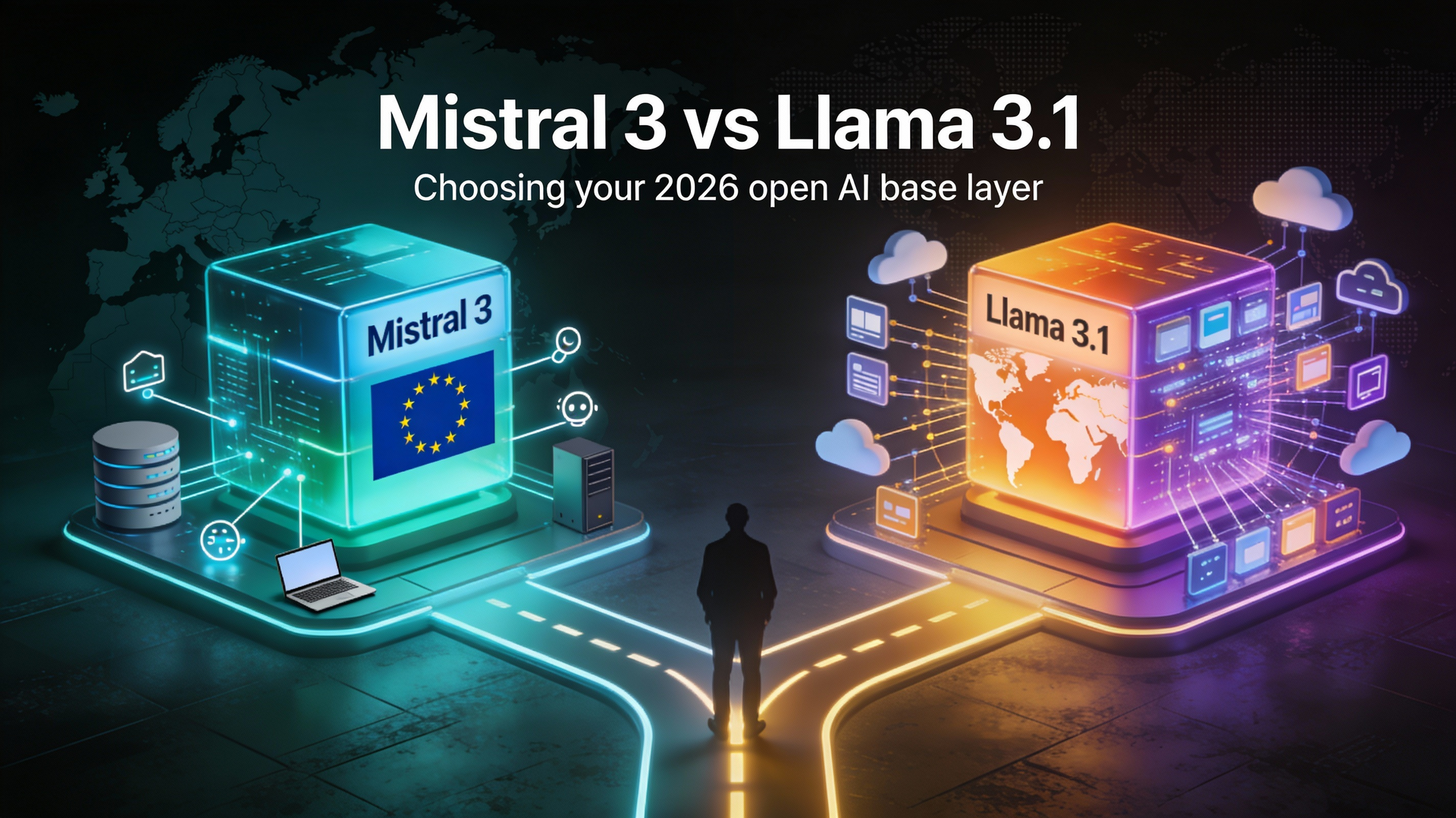
Mistral 3 and Llama 3.1 now anchor the open-source AI stack in 2026, forcing CTOs to choose between a sovereign, Apache-licensed European family and a globally dominant, ecosystem-rich US model suite.
For European SMEs and regulated enterprises, the real decision is no longer “OpenAI or Anthropic?” but which open base layer—Mistral or Llama—will power copilots, agents, and data‑intensive workflows over the next three years.
2026: the year of the open AI base layer
In 2024 and 2025, proprietary APIs set the pace; by 2026, open‑weight models have caught up enough that architecture decisions are shifting from “which provider?” to “which open foundation?”.
Mistral and Llama sit at the center: both families offer long‑context, multilingual, general-purpose LLMs strong enough for production copilots, but they differ sharply in terms of governance, deployment patterns, and cost envelopes at scale.
Mistral 3: sovereign, Apache‑licensed, and built for efficiency
Mistral 3 is a complete, Apache‑licensed, open‑weight family: compact Ministral 3 models at 3B, 8B ,and 14B parameters plus Mistral Large 3, a sparse mixture‑of‑experts flagship with 675B total parameters and 41B active.
All models support multimodal inputs and long context, with Mistral Large 3 offering up to a 256K token window—enough to keep entire policy binders, multi‑year contracts or weeks of logs in working memory for an agent.
The smaller Ministral 3B/8B/14B variants are tuned for edge and local deployments and ship in Base, Instruct, and Reasoning flavours.
Recommended VRAM footprints start around 8–24 GB, which makes it realistic to run serious reasoning models on a single mid‑range GPU, on‑prem clusters, or even high‑end laptops for development.
Strategically, Mistral leans into “from cloud to edge” and EU sovereignty: every model in the 3‑series is Apache 2.0, self‑hostable and optimized for NVIDIA hardware, with integrations into vLLM, llama.cpp, Ollama, LM Studio, and multiple cloud partners.
For EU institutions and sectors like banking, healthcare and public services, that combination—permissive licensing, long context, and on‑prem‑first story—turns Mistral 3 into a credible standard base layer rather than a niche alternative.
Llama 3.1: long‑context scale and ecosystem gravity
Llama 3.1 extends Meta’s family with three core sizes—8B, 70B and 405B parameters—each available as base and instruction‑tuned models with a shared 128K token context window.
The 8B variant is optimized for efficient deployment and experimentation on consumer‑class GPUs, the 70B model underpins large‑scale AI‑native applications, and the 405B giant is aimed at roles like synthetic data generation, LLM‑as‑a‑judge and high‑end reasoning.
All Llama 3.1 models are multilingual out of the box, supporting eight languages (including English, German, French, Italian, Portuguese, Hindi, Spanish and Thai) and offering built‑in tool‑use capabilities.
Meta bundles Llama 3.1 with a safety and tooling layer—Llama Guard 3, Prompt Guard and rich evaluation assets—which makes it easy for platform teams to plug the models into production pipelines without building the full safety stack themselves.
Distribution is where Llama 3.1 really dominates: all sizes are available via AWS Bedrock and other major clouds, deeply integrated with Hugging Face, and widely surfaced through tools like Ollama and local‑inference wrappers.
As a result, Llama 3.1 has become the default “open standard” many vendors wrap, so choosing it often means inheriting a mature ecosystem of adapters, fine‑tunings and domain‑specific variants.
Mistral 3 vs Llama 3.1: trade‑offs that matter
|
Dimension |
Mistral 3 family |
Llama 3.1 family |
|---|---|---|
|
Origin & control |
Independent French startup with strong EU‑sovereign positioning. |
Meta‑backed, US‑based big‑tech project. |
|
Lineup |
Ministral 3B/8B/14B (dense) + Mistral Large 3 (675B total, 41B active MoE). |
8B, 70B, 405B dense models, base + instruct variants. |
|
Context |
Up to 256K tokens on Mistral Large 3 and selected small models. |
128K tokens across all Llama 3.1 models. |
|
Licensing |
Apache 2.0 open weights for the entire family; very permissive for commercial use. |
Permissive Llama license, but project stewarded and branded by Meta. |
|
Deployment focus |
“Cloud to edge” with explicit VRAM targets and CPU‑friendly options. |
Cloud and GPU‑centric; 8B local is easy, 70B/405B mostly data‑center. |
|
Ecosystem |
Fast‑growing, strong in OSS runtimes, but younger overall. |
Massive: clouds, MLOps tools, vendors and community adapters. |
|
Cost signals |
Emphasis on small, efficient models and Apache licensing for ROI‑driven teams. |
Strong price‑performance on 8B/70B, especially via hyperscalers. |
Recent comparative analyses are broadly consistent: Llama 3.1 70B often leads on raw benchmark scores and some math/coding tasks, while Mistral’s small and mid‑sized models punch above their weight in latency‑ and cost‑sensitive scenarios.
For many enterprises, that means Llama 3.1 is the “research and experimentation” workhorse, whereas Mistral 3 becomes the production engine where sovereignty, efficiency and predictable cost matter more than squeezing the last few benchmark points.
How to choose your 2026 open AI stack
If you are a European bank, insurer or public‑sector organization, Mistral 3 often aligns better with your legal, operational and political constraints.
Apache‑licensed open weights, 256K context, strong edge performance and explicit “from cloud to H‑series GPU clusters” guidance make it straightforward to build compliant, self‑hosted copilots and RAG systems that never leave EU infrastructure.
If you are building a global SaaS product or AI platform, Llama 3.1’s ecosystem gravity becomes a major advantage.
Using Llama 3.1 on AWS Bedrock or similar platforms lets you tap into ready‑made ops, safety tooling and a huge pool of engineers, libraries and pretrained adapters, which can compress time‑to‑market dramatically.
In practice, 2026 architecture decisions rarely boil down to a single model family.
A pragmatic pattern is hybrid: use Llama 3.1‑70B or 405B in R&D and for high‑capacity global features, while standardizing on Mistral 3 (Ministral 8B/14B for edge, Large 3 for core reasoning) for regulated production workloads where you must control every part of the stack.
Dr. Hernani Costa
Founder & CEO of First AI Movers